
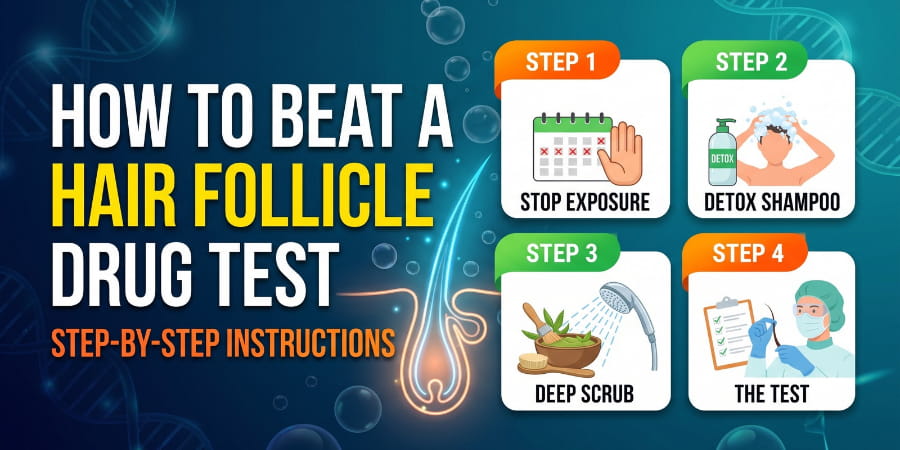
Facing an upcoming hair follicle drug test can be one of the most stressful and nerve-wracking turning points in your professional or personal life. Unlike urine, saliva, or blood screenings that only capture recent substance use over a span of a few days or weeks, hair follicle testing has an extensive look-back window that typically spans 90 days or more. When microscopic drug metabolites enter your bloodstream, they circulate and become permanently locked inside the inner protein structure—known as the cortex—of your growing hair strands.
Because these chemical residues are embedded deep within the keratin matrix, standard drugstore shampoos, ordinary clarifying washes, and basic household remedies are completely powerless against them. Scrubbing the surface of your hair does nothing to dissolve or extract toxins sealed deep inside the hair shaft. If you want to protect your job offer, career advancement, professional licensing, or legal standing, you cannot afford to rely on unverified online myths, ineffective home hacks, or desperate measures like shaving your head (which often triggers alternative body hair testing or suspicious red flags).
Instead, you need a scientifically structured, heavy-duty detoxification protocol backed by decades of real-world results. This comprehensive master guide breaks down the complex science of hair testing, exposes why normal methods fail, details the gold-standard protocol, and provides a foolproof, step-by-step execution strategy to help you successfully pass your hair follicle drug test.
The Science Behind Hair Follicle Drug Testing
To successfully beat a hair follicle drug test, you must first understand how laboratories analyze hair specimens and how drug residues become permanently trapped in your body.
1. The Metabolite Pathway from Bloodstream to Hair Shaft
When any substance is consumed, your body metabolizes it, breaking the parent compound down into chemical byproducts called metabolites. These metabolites enter your bloodstream and circulate throughout your entire body. As hair cells multiply and grow rapidly within the hair follicle beneath the scalp, blood vessels supply nutrients and deposit these circulating metabolites directly into the growing hair structure. As the hair pushes outward and hardens (keratinizes), the metabolites become permanently sealed inside.
2. The Three Layers of Hair and the Cortex Trap
A single strand of human hair is composed of three distinct microscopic layers:
- The Cuticle (Outer Layer): Composed of overlapping protective scales that resemble roof shingles. In healthy, untreated hair, the cuticle remains tightly closed, sealing the inner layers against environmental pollutants and washing agents.
- The Cortex (Middle Layer): This is the thickest structural layer of the hair shaft, packed with fibrous proteins and lipids. This is where drug metabolites bind permanently. Because metabolites are oil-soluble, they dissolve into the lipid matrix of the cortex during hair growth.
- The Medulla (Inner Core): The innermost channel of the hair shaft, which is sometimes absent in fine hair.
3. The 1.5-Inch Rule and the 90-Day Detection Window
Standard laboratory testing protocols established by organizations like the Substance Abuse and Mental Health Services Administration (SAMHSA) typically require a hair sample measuring 1.5 inches in length, cut as close to the scalp as possible from the crown of the head.
- Hair grows at a remarkably consistent average rate of approximately 0.5 inches per month.
- Therefore, a standard 1.5-inch hair snippet provides an exact historical timeline representing the previous 90 days of drug history.
- If testing body hair (such as chest, arm, leg, or underarm hair), the growth rate is significantly slower (growing in cycles rather than continuously), meaning body hair can store drug metabolites for up to a year or more.
4. Laboratory Testing Methodology: ELISA and GC-MS / LC-MS-MS
Testing facilities do not simply look at hair under a microscope; they employ a rigorous, two-tier analytical procedure:
- Initial Screening (ELISA): Laboratories first wash the exterior of the hair to remove environmental contaminants, dissolve the hair sample completely using specialized enzymes, and run an Enzyme-Linked Immunosorbent Assay (ELISA). This preliminary test screens for the presence of drug metabolites above established cutoff thresholds.
- Confirmatory Testing (GC-MS / LC-MS-MS): If an initial sample screens positive, the laboratory subjects the extract to Gas Chromatography-Mass Spectrometry (GC-MS) or Liquid Chromatography-Tandem Mass Spectrometry (LC-MS-MS). These advanced technologies separate and quantify specific molecular fragments with extreme precision, virtually eliminating false positives and confirming true drug history.
Why Normal Shampoos, Home Remedies, and Myths Fail
When individuals discover they have an impending hair test, panic often leads them to try unverified home remedies found on random internet forums. Understanding why these methods fail prevents costly mistakes.
1. The Surface-Cleaning Limitation of Regular Shampoos
Commercial shampoos, antidandruff products, and standard clarifying washes are formulated exclusively to cleanse surface-level sebum, dirt, sweat, and environmental dust. They possess zero chemical capability to open the overlapping cuticle scales or penetrate the inner protein cortex where drug metabolites are chemically bonded. Washing your hair 20 times a day with regular shampoo will clean your scalp, but it will leave trapped metabolites entirely untouched.
2. The Oil-Soluble Lipid Bonding Challenge
Drug metabolites (particularly THC metabolites like THC-COOH) are highly lipophilic (fat-loving) and hydrophobic (water-repelling). They bind tightly within the natural fatty lipids of the hair cortex. Water, basic soap, and standard surfactants cannot dissolve, break down, or extract these lipid-bound residues.
3. The Dangerous Shaving Trap
A widespread myth suggests that shaving your head completely will allow you to evade the test. In reality, this is a fatal error:
- If testing technicians find zero head hair, they are authorized to collect body hair from your chest, arms, legs, or back.
- Furthermore, arriving at a testing clinic completely bald or with newly shaved head hair immediately raises red flags for test administrators, often resulting in an automatic failure, a suspended testing status, or an alternative oral/blood screening.
4. Ineffective Home Hacks (Baking Soda, Lemon Juice, Bleach Alone)
- Lemon Juice & Vinegar Rinses: While acidic solutions slightly alter surface pH, home applications without structured chemical catalysts cannot open the cortex deeply enough to flush out embedded metabolites.
- Bleaching Alone: Many believe bleaching fries the hair and destroys all evidence. While bleaching strips away roughly 30% to 40% of hair pigments and surface metabolites by causing structural swelling, it does not eliminate 100% of embedded cortex residues. High-sensitivity GC-MS lab equipment will still detect surviving metabolites unless bleaching is paired with a specialized, aggressive purification protocol.
The Gold Standard Solution – Mike’s Macujo Method
For over two decades, Mike’s Macujo Method has stood undisputed as the most reliable, scientifically structured multi-step cleansing protocol designed to beat strict hair follicle drug screenings. Developed by industry veteran Mike Macujo, this advanced 9-step system is engineered to permanently open the hair cuticle, dissolve lipid bonds in the cortex, flush out embedded metabolites, and restore hair integrity.
What You Will Need for the Complete Protocol:
- Macujo Aloe Rid® Shampoo: The premier, authentic specialized detox shampoo containing high concentrations of propylene glycol and EDTA to act as a deep-penetrating chelating agent.
- Heinz Vinegar (White or Apple Cider): Used to introduce a controlled acidic environment that swells the hair shaft and prepares the cuticle for deep cleansing.
- Clean & Clear Deep Cleaning Astringent (Pink) (2% Salicylic Acid): A powerful topical astringent that penetrates oil-clogged pores and hair lipid barriers to dissolve stubborn residues.
- Arm & Hammer Baking Soda: Used in the preparatory alkaline phase to swell and open the hair cuticle scales.
- Tide Liquid Laundry Detergent (Used Sparingly): Acts as an aggressive surfactant to cut through heavy chemical residues trapped in the cortex.
- Zydot Ultra Clean Shampoo: The mandatory test-day finishing treatment used to strip away external environmental contaminants and second-hand smoke immediately before your lab appointment.
Step-by-Step Execution of the 9-Step Macujo Protocol
To achieve optimal results, this multi-step cleansing procedure should be performed consistently over 3 to 7 consecutive days leading up to your lab appointment, guided by your personal usage history and exposure levels.
View the Complete 9-Step Macujo Method Guide → .
Determining Your Personal Wash Requirements
There is no universal “one-size-fits-all” number of washes because human biology, metabolism, body composition, hair texture, and substance exposure histories vary drastically from person to person.
- The Mike Macujo Required Washes Calculator: Instead of guessing or following generic internet advice, users should input their precise usage history into the official online wash calculator.
- Input Parameters: The calculator evaluates the specific substance used, the exact date of last use, and the frequency of use during the preceding 90 days.
- Built-In Safety Margins: To account for individual application differences and potential user error, calculator recommendations routinely factor in one to three extra cleansing sessions as an added safety margin.
- Multi-Substance Routing: If multiple substances are involved, your target wash count must align with the most difficult substance to clear (such as heavy THC or cocaine). For isolated cocaine exposure, specialized protocols like Mike’s Cocaine Method may apply.
Test-Day Insurance and Environmental Safeguards
Successfully executing the multi-step cleansing protocol is crucial, but protecting your newly purified hair from accidental re-contamination on test day is equally mandatory.
1. Preventing Re-Contamination
Once your hair has been fully cleansed, never wear unwashed hoodies, beanies, hats, or caps that contain old sweat, oils, or residue. Furthermore, avoid using contaminated hairbrushes, combs, headbands, or pillowcases. Wash all bedding, headwear, and hair tools immediately, or replace them entirely to prevent transferring old toxins back onto your clean hair.
2. The Zydot Ultra Clean Test-Day Insurance Policy
On the exact morning of your scheduled laboratory appointment, use Zydot Ultra Clean Shampoo as your final step right before leaving for the testing facility. Zydot acts as an internal and external purifying treatment that strips away ambient environmental pollutants, chlorine, hard water minerals, and second-hand smoke residue that may have settled on your hair since your last wash.
3. At-Home Verification with a Home Hair Test Kit
Before stepping into the official testing facility, highly cautious individuals utilize a certified 18-drug Home Hair Test Kit. By collecting a small hair sample and mailing it to a private lab using the pre-paid envelope, you receive confidential results within days, providing absolute peace of mind and confirmation that your detox efforts were successful.
Frequently Asked Questions (FAQs)
Can light or one-time drug use be detected in a hair test?
Yes. Hair follicle tests are exceptionally sensitive and designed to detect even trace amounts of drug metabolites, though heavy or chronic users accumulate significantly higher concentrations in the cortex.
Are nine steps the same thing as nine individual washes?
No. Steps 1 through 9 constitute one complete cleansing session. Depending on your exposure history from the wash calculator, you may need to repeat this complete 9-step session multiple times over several days.
Can I use generic drugstore shampoos labeled “Aloe Rid” instead of the authentic product?
No. Authentic Macujo Aloe Rid® Shampoo contains the exact proprietary formulation (high propylene glycol and EDTA) required for Mike’s method. Using unverified imitations or counterfeit bottles risks total failure.
What happens if I have no head hair left to test?
Testing collectors will simply extract body hair from your chest, arms, legs, or back, which retains drug metabolites over an even longer timeframe.